

Sweat-Powered Finger Wrap Enables Continuous Health Monitoring
Engineers at the University of California San Diego have developed a sweat-powered finger wrap that monitors vital health biomarkers such as glucose, lactate, vitamin C, and levodopa. This wearable device utilizes sweat from the wearer’s fingertip for both power and health monitoring, making it a convenient and non-invasive tool for personalized health tracking.
The fingertip is one of the body’s most efficient sweat producers, equipped with thousands of sweat glands. Unlike other areas of the body, fingertips produce sweat continuously, even when at rest or asleep. Engineers at UC San Diego have harnessed this constant, natural perspiration to power a wearable finger wrap that monitors a range of chemical levels in the sweat. This device has the potential to revolutionize personalized health monitoring by enabling continuous, effortless tracking.
Joseph Wang, a professor in the Department of Chemical and Nano Engineering at UC San Diego, explains: “It is based on a remarkable integration of energy harvesting and storage components, with multiple biosensors in a fluidic microchannel, along with the corresponding electronic controller, all at the fingertip.”
How the finger wrap works
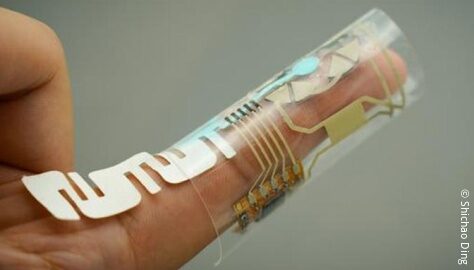
The device is made from a thin, flexible polymer that fits snugly around the finger. It features biofuel cells that convert chemicals in sweat into electricity, which is then stored in two stretchable batteries. These batteries power four sensors, each designed to track a specific biomarker—glucose, vitamin C, lactate, and levodopa (used to treat Parkinson’s disease).
The sweat is wicked through microfluidic channels to the sensors, where biomarker levels are analyzed. The collected data is then wirelessly transmitted to a custom smartphone or laptop application via Bluetooth. This design allows for continuous monitoring without any physical activity or external stimuli required to generate sweat.
Continuous monitoring, even during rest
One of the device’s key features is its ability to function during periods of inactivity or sleep. During tests, a participant wore the device throughout the day to monitor glucose levels during meals, lactate levels during exercise and desk work, and vitamin C levels while consuming orange juice. The device also tracked levodopa levels after the participant consumed fava beans, a natural source of the drug.
Potential for customization and advanced treatment
The device can be customized to monitor different sets of biomarkers based on individual health needs. Researchers are working on a closed-loop system that not only monitors biomarkers but also administers treatments based on the data collected. For example, the device could potentially monitor glucose levels and automatically administer insulin to diabetic patients, while simultaneously tracking the effectiveness of the treatment.
#University of California San Diego #GenZGrowth #Pasticsnews #ModernPlasticsIndiaMagazine
#PrintPublication #PrintMagazine #Modernhealthcareindia