

Wearable Ultrasound Patch: Addressing Limitations Of Traditional Blood Pressure Monitoring
Researchers at the University of California San Diego have developed a clinically validated, wearable ultrasound patch for continuous blood pressure monitoring. Published in Nature Biomedical Engineering, this technology offers a noninvasive, reliable alternative to traditional methods, such as arterial lines and blood pressure cuffs, with applications in both clinical and home settings.
Traditional methods of measuring blood pressure, like cuffs or arterial lines, have notable limitations. Cuffs provide only single-point readings, potentially missing critical trends. Arterial lines, while highly accurate, are invasive, limit patient mobility, and can cause discomfort.
“Our wearable patch offers a continuous stream of blood pressure waveform data, allowing it to reveal detailed trends in blood pressure fluctuations,” said Sai Zhou, study co-first author and recent Ph.D. graduate from the UC San Diego Jacobs School of Engineering. This patch overcomes these challenges by continuously measuring blood pressure noninvasively, offering detailed and real-time data on vascular health.
How the wearable ultrasound patch works
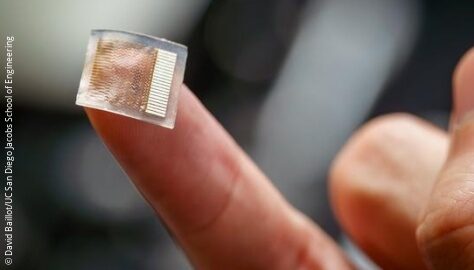
The patch, roughly the size of a postage stamp, is soft, flexible, and adheres to the skin. When worn on the forearm, it uses ultrasound waves to track changes in blood vessel diameter. These changes are then converted into blood pressure values. Key components of the device include:
- Silicone elastomer: Provides stretchability and durability.
- Piezoelectric transducers: Packed densely for enhanced precision, these sensors transmit and receive ultrasound waves.
- Stretchable copper electrodes: Facilitate signal transmission.
Technological improvements include closer transducer spacing for wider coverage of smaller, clinically relevant arteries and a damping layer to enhance signal clarity.
Clinical validation and results
The patch underwent comprehensive clinical testing on 117 participants, including patients in intensive care units and cardiac catheterization labs. Key findings include:
- Comparable accuracy to arterial lines and blood pressure cuffs.
- Effective operation during daily activities such as cycling, eating, and meditation.
- Reliable performance across various postures, such as sitting, standing, and lying down.
The patch demonstrated its potential as a noninvasive alternative to arterial lines, especially in critical care settings, while ensuring patient comfort and mobility.
“A big advance of this work is how thoroughly we validated this technology,” said Sheng Xu, lead researcher and professor at the UC San Diego Jacobs School of Engineering. “Blood pressure can vary due to factors like daily activities, medications, or white coat syndrome, which makes it tricky to get an accurate diagnosis or manage treatment. That’s why it was so important for us to test this device in a wide variety of real-world and clinical settings. Many studies on wearable devices skip these steps during development, but we made sure to cover it all.”
Future Directions for the patch
The research team is now preparing for large-scale clinical trials. Plans include integrating machine learning algorithms to enhance accuracy further and developing a wireless, battery-powered version for long-term use. The ultimate goal is seamless integration into hospital systems and remote monitoring technologies for home care.
#University of California San Diego #GenZGrowth #Pasticsnews #ModernPlasticsIndiaMagazine
#PrintPublication #PrintMagazine #Modernhealthcareindia