
By using this site, you agree to the Privacy Policy and Terms of Use.
Accept
Modern Healthcare IndiaModern Healthcare IndiaModern Healthcare India
Notification Show More
Font ResizerAa
  • Home
  • News & Perspective
    News & PerspectiveShow More
    TAGMA 2026 to Unveil Advanced Tooling Solutions at Die & Mould India Expo
    By Modernhealthcare
  • Health Conditions
    Health Conditions
    The World Health Organization defines health as “a state of complete physical, mental, and social well-being and not merely the absence of disease or infirmity.”…
    Show More
    Top News
    NR Foundation Reinforces Commitment To Community Healthcare In Mysuru
    February 17, 2026
    Latest News
    NR Foundation Reinforces Commitment To Community Healthcare In Mysuru
    February 17, 2026
  • Nutrition & Fitness
    Nutrition & FitnessShow More
  • Beauty Lab
    Beauty LabShow More
  • Team
  • Contact
Modern Healthcare IndiaModern Healthcare India
Font ResizerAa
  • Food & Diet
  • Beauty Lab
  • Anatomy
  • Health Conditions
  • News & Perspective
  • Nutrition & Fitness
Search
  • Home
  • Digital Health
  • Medical Research
  • Medical Diagnostics
  • Artificial Intelligence in Healthcare
  • Health Conditions
  • Team
  • Contact
Follow US
Medical Diagnostics

Early Detection: Machine Learning In Cardiovascular Diagnostics

Rupali
Last updated: February 7, 2026 5:36 am
By Rupali
Share
3 Min Read
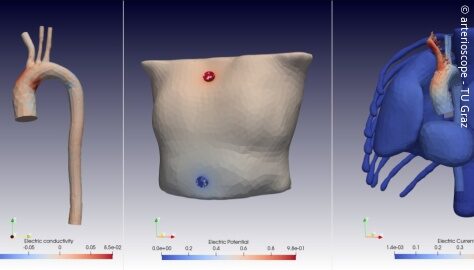
Changes in the electric fields can be precisely analysed in the simulations.
SHARE

Early Detection: Machine Learning In Cardiovascular Diagnostics

Researchers at Graz University of Technology have developed a method for the early detection of cardiovascular diseases before symptoms occur. Using a machine learning model that analyzes electric fields, potential diseases can be precisely identified. This technology could improve diagnostics and reduce invasive interventions. 

Cardiovascular diseases are among the most common causes of death worldwide. They are often only diagnosed when symptoms are already advanced. As part of the lead project “Mechanics, Modeling and Simulation of Aortic Dissection”, Graz University of Technology researchers Sascha Ranftl and Vahid Badeli have developed a new method to detect these diseases at an early stage. This method makes it possible to analyze changes in the cardiovascular system by observing electrical fields.

Sascha Ranftl explains: “The basic principle is that any disease that changes the cardiovascular mechanics will also change the externally applied electrical field in a certain way. This applies to arteriosclerosis, aortic dissection, aneurysms, heart valve defects, etc.”

Early detection through digital twins

The method is based on the analysis of electrical, optical and bioimpedance signals, such as those recorded by an ECG or a smartwatch. This data is evaluated using a machine learning model that recognizes changes that indicate possible cardiovascular disease. The advantage: even subtle deviations that are difficult for doctors to recognize can be identified by the model.

The model was trained using real clinical data and simulated values of the cardiovascular system and achieves an accuracy of over 90 percent. This enables the researchers to determine the degree of arterial stiffening, an early indicator of aortic dissection. By using a digital twin that simulates the condition of the arteries, the course of the disease can be predicted in detail.

Interdisciplinary collaboration leads to success

The success of this research is due to the close collaboration between physicists and electrical engineers. By combining their disciplines, the researchers were able to break down the connection between mechanical changes in the cardiovascular system and the effects on electrical fields. These findings make it possible to treat cardiovascular diseases earlier and possibly replace invasive operations with drug therapies.

Future prospects

The researchers at the TU Graz spin-off arterioscope are continuing to work on improving the accuracy of their models and developing them further for clinical application. This research is being driven forward in the strategic fields of “Human & Biotechnology” and “Information, Communication & Computing” at TU Graz.

www.tugraz.at/en

#Graz University of Technology #GenZGrowth #Pasticsnews #ModernPlasticsIndiaMagazine
#PrintPublication #PrintMagazine #Modernhealthcareindia

Share This Article
Facebook Copy Link Print

World Health Expo 2026 Reinforces Dubai’s Role As Global Hub For Healthcare Collaboration & Innovation
Wolters Kluwer Survey Finds Broad Presence Of Unsanctioned AI Tools In Hospitals And Health Systems
Unitedhealth Posts Modest Earnings Beat, Soft Revenue Guidance As Insurer Plots Turnaround

You Might Also Like

Medical Diagnostics

Mobile One Health Laboratory Enables On-Site Pathogen Diagnostics

By Rupali
Linkedin Facebook Youtube Instagram X-twitter Telegram
MODERN BUSINESS GLOBAL NETWORK

Modern Business India
Modern Business Asia
Modern Business Europe
Modern Business America
Modern Business Gulf

Load More

MODERN PLASTICS GLOBAL NETWORK

Modern Plastics India
Modern Plastics Asia
Modern Plastics Europe
Modern Plastics America
Modern Plastics Global

Load More

WOMEN INDIA NETWORK

Women India Network
Women India
Beauty N Fitness India
Beauty N Fitness Times
Modern Fashion Life Style

Load More

All Rights Reserved,  © 2000 – 2026. Modern Healthcare India and its related marks are registered trademarks of Chrysolite Media Network Pvt. Ltd., Mumbai (IN).

Powered by
...
►
Necessary cookies enable essential site features like secure log-ins and consent preference adjustments. They do not store personal data.
None
►
Functional cookies support features like content sharing on social media, collecting feedback, and enabling third-party tools.
None
►
Analytical cookies track visitor interactions, providing insights on metrics like visitor count, bounce rate, and traffic sources.
None
►
Advertisement cookies deliver personalized ads based on your previous visits and analyze the effectiveness of ad campaigns.
None
►
Unclassified cookies are cookies that we are in the process of classifying, together with the providers of individual cookies.
None
Powered by
Welcome Back!

Sign in to your account

Username or Email Address
Password

Lost your password?