

Early Detection: Machine Learning In Cardiovascular Diagnostics
Researchers at Graz University of Technology have developed a method for the early detection of cardiovascular diseases before symptoms occur. Using a machine learning model that analyzes electric fields, potential diseases can be precisely identified. This technology could improve diagnostics and reduce invasive interventions.
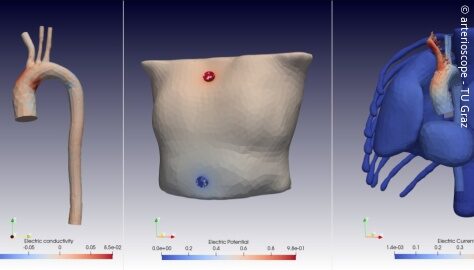
Cardiovascular diseases are among the most common causes of death worldwide. They are often only diagnosed when symptoms are already advanced. As part of the lead project “Mechanics, Modeling and Simulation of Aortic Dissection”, Graz University of Technology researchers Sascha Ranftl and Vahid Badeli have developed a new method to detect these diseases at an early stage. This method makes it possible to analyze changes in the cardiovascular system by observing electrical fields.
Sascha Ranftl explains: “The basic principle is that any disease that changes the cardiovascular mechanics will also change the externally applied electrical field in a certain way. This applies to arteriosclerosis, aortic dissection, aneurysms, heart valve defects, etc.”
Early detection through digital twins
The method is based on the analysis of electrical, optical and bioimpedance signals, such as those recorded by an ECG or a smartwatch. This data is evaluated using a machine learning model that recognizes changes that indicate possible cardiovascular disease. The advantage: even subtle deviations that are difficult for doctors to recognize can be identified by the model.
The model was trained using real clinical data and simulated values of the cardiovascular system and achieves an accuracy of over 90 percent. This enables the researchers to determine the degree of arterial stiffening, an early indicator of aortic dissection. By using a digital twin that simulates the condition of the arteries, the course of the disease can be predicted in detail.
Interdisciplinary collaboration leads to success
The success of this research is due to the close collaboration between physicists and electrical engineers. By combining their disciplines, the researchers were able to break down the connection between mechanical changes in the cardiovascular system and the effects on electrical fields. These findings make it possible to treat cardiovascular diseases earlier and possibly replace invasive operations with drug therapies.
Future prospects
The researchers at the TU Graz spin-off arterioscope are continuing to work on improving the accuracy of their models and developing them further for clinical application. This research is being driven forward in the strategic fields of “Human & Biotechnology” and “Information, Communication & Computing” at TU Graz.
#Graz University of Technology #GenZGrowth #Pasticsnews #ModernPlasticsIndiaMagazine
#PrintPublication #PrintMagazine #Modernhealthcareindia